



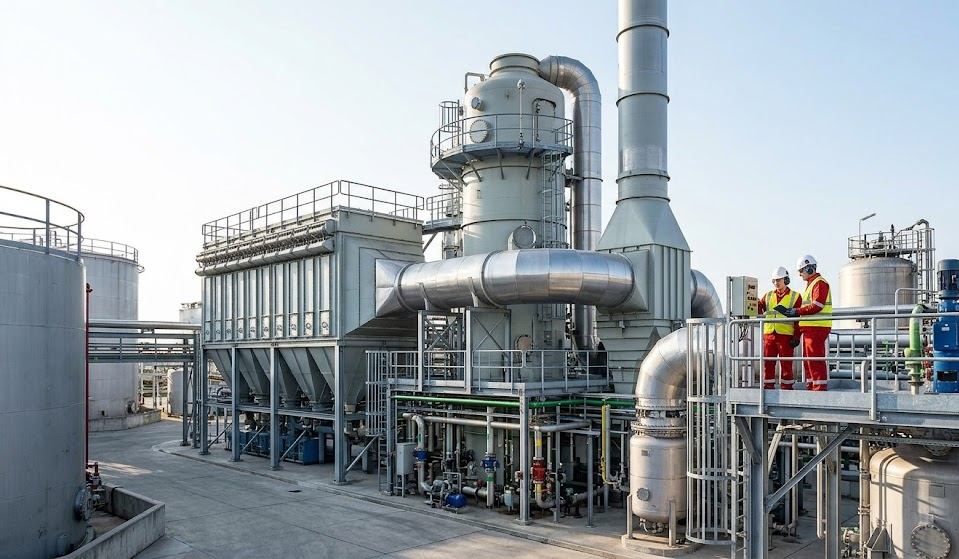
Chemical industries operate with complex processes that generate a wide range of emissions, including gases, vapours, and fine particulates. Managing these emissions efficiently requires advanced air pollution control equipment designed specifically for process conditions.
Today, industries rely on well-engineered air pollution control equipment in industries to ensure smooth operations, consistent performance, and effective emission management across chemical manufacturing plants.
Engineering-driven companies such as Ecomak Systems, known for delivering advanced air pollution control equipment in industries, contribute to developing solutions aligned with real chemical plant environments.
This blog explains the types of air pollution control equipment, their applications in chemical industries, and how to select the right systems.
Understanding Emissions in Chemical Industries
Chemical manufacturing processes generate diverse emission types, including:
- Acidic gases (HCl, SO₂, NOx)
- Chemical vapours and fumes
- Fine particulate matter
- Process exhaust gases
These emissions require specialized industrial air pollution control equipment to ensure efficient handling.
Among these, acid gas removal plays a critical role in chemical industries where gaseous emissions are dominant.
Key Air Pollution Control Equipment Used in Chemical Industries
Different processes require different technologies. The most widely used air pollution control equipment in industries for chemical plants includes:
1. Industrial Scrubber Systems
An industrial scrubber system is one of the most widely used technologies in the chemical industry.
These systems are specifically designed for:
- Acid gas removal
- Chemical vapour treatment
- Gas absorption processes
Common types include:
- Packed bed scrubbers: Packed bed scrubbers use structured or random packing material to increase the contact surface between gas and liquid. This enhances mass transfer efficiency, making them highly effective for continuous acid gas removal in chemical processes.
- Venturi scrubbers: Venturi scrubbers operate at high gas velocities, creating fine liquid droplets that capture both particulate matter and gaseous pollutants. These systems are suitable for applications where both dust and gas-phase emissions are present.
- Spray tower scrubbers: Spray towers use liquid sprays to interact with the gas stream. They are simpler in design and are used in applications where moderate gas absorption efficiency is required.
An industrial scrubber system uses liquid absorption to neutralize or remove harmful gases from exhaust streams, making it essential for chemical processing plants.
2. Acid Gas Removal Systems
Acid gas removal is a critical function in chemical industries where emissions contain acidic compounds.
Specialized systems are used to:
- Remove hydrogen chloride (HCl)
- Treat sulfur dioxide (SO₂)
- Neutralize process gases
Types of Acid Gas Removal Approaches
- Alkaline Scrubbing Systems: These systems use alkaline solutions such as caustic or lime-based reagents to neutralize acidic gases. They are commonly integrated within industrial scrubber systems.
- Multi-Stage Scrubbing Systems: In processes with multiple pollutants, multi-stage systems are used where different stages target specific gases, improving overall acid gas removal efficiency.
- Absorption-Based Systems: These systems rely on chemical absorption reactions to remove gases from process streams, ensuring effective gas treatment in chemical industries.
These systems are often integrated within industrial scrubber systems to ensure effective gas treatment.
3. Dust Collection Systems
While chemical industries are largely gas-focused, many processes also generate particulate matter.
A dust collection system is used for:
- Powder handling operations
- Material transfer points
- Dry chemical processing
Common systems include:
- Baghouse dust collectors: A baghouse dust collector uses fabric filter bags to capture fine particulate matter. These systems are widely used for high-efficiency dust filtration in chemical plants.
- Pulsejet baghouse systems: Pulsejet systems use compressed air pulses to clean filter bags during operation, allowing continuous performance and stable filtration efficiency.
- Mechanical Dust Collectors: Mechanical systems such as cyclones use centrifugal force to separate larger particles from the gas stream. These are often used as pre-collectors before high-efficiency filtration systems.
These systems support overall air pollution control equipment in industries by managing particulate emissions.
4. Fume Extraction Systems
A fume extraction system captures process fumes at the source, especially during:
- Reactor operations
- Mixing and blending
- Storage tank venting
Types of Fume Extraction Systems
- Source Capture Systems: These systems use hoods placed near emission sources such as reactors and mixers to capture fumes directly at the point of generation.
- Canopy Hood Systems: Installed above process equipment, canopy hoods capture rising fumes from open processes such as blending and material handling.
- Ducted Extraction Systems: These systems transport captured fumes through ducting networks to filtration units such as scrubbers or dust collectors.
These systems are essential for localized emission control and are often integrated with industrial air pollution control systems.
5. Electrostatic Precipitators (ESP)
An electrostatic precipitator is used in chemical plants handling large gas volumes with fine particulates.
These systems:
- Use an electrical charge to remove particles
- Operate efficiently under stable process conditions
Types of Electrostatic Precipitators
- Dry Electrostatic Precipitators: Used for dry particulate removal in processes where moisture levels are controlled.
- Wet Electrostatic Precipitators: Used for fine mist, aerosols, and sticky particles often present in chemical processes.
They complement other air pollution control equipment in chemical industries.
Applications Across Chemical Industry Segments
Modern air pollution control equipment in industries is used across various chemical sectors:
- Petrochemicals
- Fertilisers and pesticides
- Specialty chemicals
- Paints, dyes, and pigments
- Polymers and plastics
- Organic and inorganic chemicals
Each segment requires a tailored combination of industrial scrubber systems, acid gas removal systems, and other air pollution control equipment.
How to Select the Right Air Pollution Control Equipment
Choosing the right air pollution control equipment for chemical industries requires a detailed understanding of process conditions.
Key considerations include:
- Type of emission (gas, vapour, particulate)
- Chemical composition of exhaust
- Temperature and pressure conditions
- Process variability
- Required treatment efficiency
A well-designed system ensures that air pollution control equipment in industries performs consistently across all operating scenarios.
Integration of Air Pollution Control Equipment
In chemical plants, different systems work together as part of a complete solution.
Typical integration includes:
- Industrial scrubber systems for gas treatment
- Acid gas removal systems for chemical emissions
- Dust collection systems for particulate control
- Fume extraction systems for source capture
This integrated approach ensures effective industrial air emission control across the plant.
Engineering Expertise in Air Pollution Control Equipment
Designing efficient air pollution control equipment for chemical industries requires deep process understanding and engineering precision.
Companies like Ecomak Systems, recognized among leading air pollution control equipment manufacturers in India, specialize in delivering:
- Process-specific industrial scrubber systems
- Advanced acid gas removal solutions
- Integrated air pollution control equipment in industries
With expertise in industrial air pollution control systems, these solutions are designed to perform reliably under real chemical plant conditions.
Conclusion
Chemical industries require specialized and well-integrated air pollution control equipment to manage complex emission profiles.
From industrial scrubber systems and acid gas removal systems to dust collection systems and fume extraction systems, each technology plays a critical role in ensuring efficient emission handling.
With the right engineering approach and system integration, air pollution control equipment in industries supports efficient operations across diverse chemical processes.
FAQs:
The most commonly used systems include industrial scrubber systems, especially for acid gas removal, along with dust collection systems and fume extraction systems.
Acid gas removal helps treat emissions such as HCl and SO₂, ensuring efficient handling of gaseous pollutants generated during chemical processes.
Industrial scrubber systems are widely used in chemical, fertiliser, petrochemical, and refinery industries.
Air pollution control equipment manufacturers design customized systems based on process conditions, ensuring efficient and reliable emission control.