



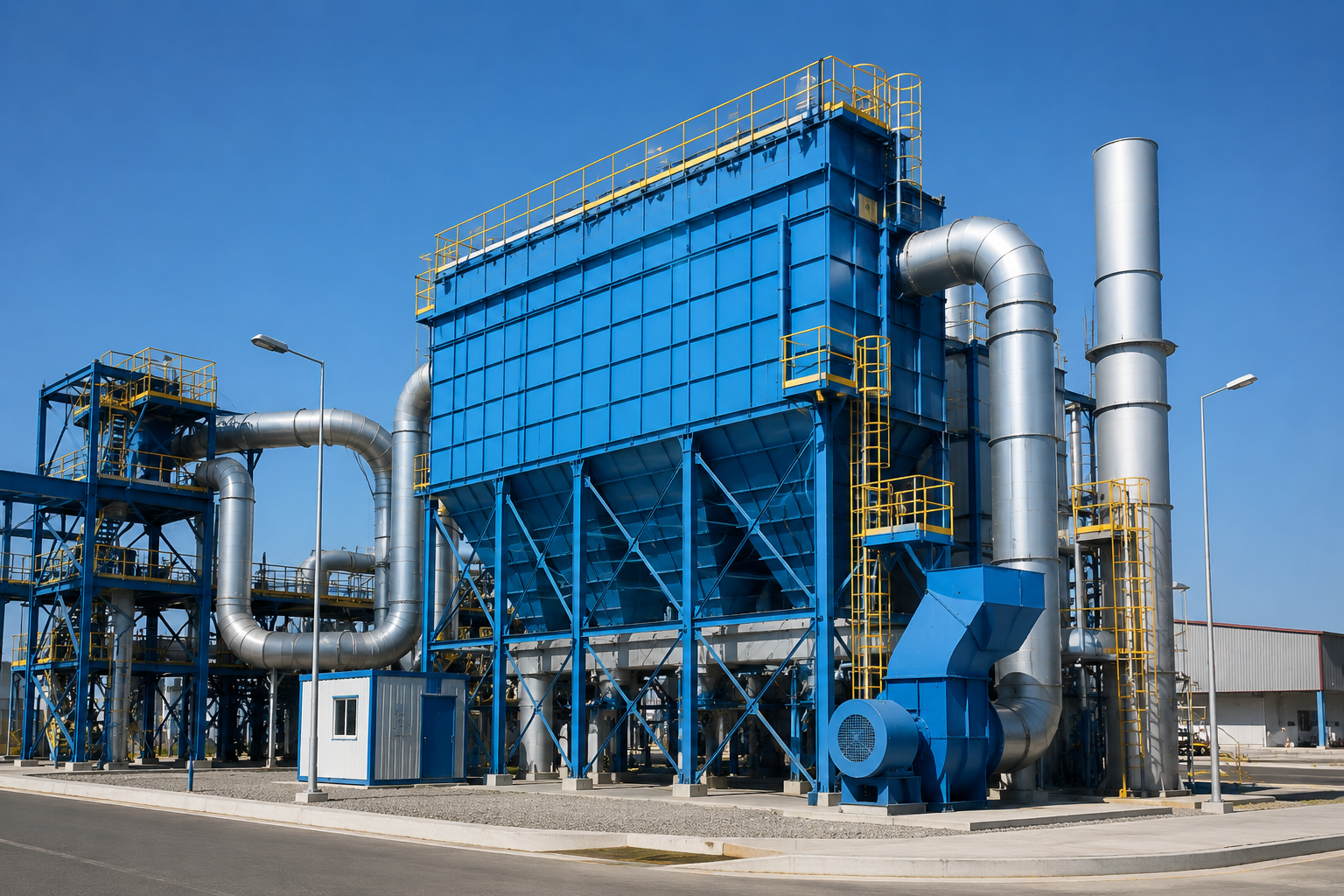
Baghouse dust collectors are widely used for controlling particulate emissions across steel, cement, power, carbon black, chemical, and other process industries. As an important component of Industrial Air Pollution Control Systems, baghouses provide efficient filtration of dust-laden gases generated during manufacturing and material-handling operations.
In India, environmental-clearance documents for industrial projects demonstrate the use of bag filters and baghouse systems across applications such as induction furnaces, steelmaking, material handling and other dust-generating processes.
What Is a Baghouse Dust Collector?
A baghouse dust collector is a fabric filtration system designed to separate particulate matter from an industrial gas stream.
In a typical baghouse dust collection system, dust-laden air enters the collector and passes through baghouse bags. The filter media retains particulate matter while the cleaned gas passes through the filtration system.
The collected dust is periodically removed through a cleaning mechanism and transferred to a suitable dust-handling system.
A baghouse typically consists of:
- Filter bags
- Filter cages
- Dust collection hopper
- Cleaning system
- Inlet and outlet arrangements
- Dust discharge system
This makes the baghouse filter an important technology for industrial air pollution control where particulate emissions need to be effectively captured.
How Does a Baghouse Dust Collector Work?
The basic working principle is straightforward:
Dust-laden gas → Filter bags → Particulate capture → Clean gas
As the gas passes through the filter media, particulate matter accumulates on the surface of the bags and forms a dust layer. The bags are periodically cleaned to maintain suitable airflow and filtration performance.
The cleaning method depends on the type of baghouse collector and the process conditions.
Types of Baghouse Dust Collectors
Pulsejet Baghouse
A pulsejet baghouse uses short bursts of compressed air to clean the filter bags. This allows online cleaning and is suitable for many applications requiring continuous operation.
Reverse Air Baghouse
A reverse air baghouse uses low-pressure reverse airflow to remove accumulated dust from the filter bags. Reverse air baghouse operation is particularly suited to applications involving large gas volumes and continuous industrial operation.
Ecomak designs both pulsejet and reverse-air baghouse systems for different industrial applications, including steel, cement, power, and process industries.
Applications of Baghouse Systems in Industries
Baghouse dust collectors are used across several industrial applications, including:
Steel Plants
In steel melting shops, baghouse systems can be integrated with fume extraction systems to capture particulate-laden fumes generated during furnace operations. Indian project documentation provides examples of furnace fume extraction systems connected to bag filters and baghouse systems.
Cement Plants
Baghouses are used for particulate control across material handling, grinding, kiln-related and other dust-generating processes.
Carbon Black Manufacturing
Specialized Carbon Black Bag Collector and Carbon Black Bag Collector Package configurations are used for fine particulate filtration in carbon black manufacturing and related process applications.
Power and Boiler Applications
Baghouse systems can also be applied to selected boiler exhaust and combustion-related processes, depending on gas characteristics and plant configuration.
How Ecomak Designs Baghouse Systems
Ecomak Systems develops customized air pollution control equipment based on process conditions, gas volume, dust characteristics, temperature and required filtration performance.
Its baghouse portfolio includes pulsejet baghouse and reverse air baghouse systems, with configurations designed for different industrial applications.
Ecomak’s approach combines equipment design with system-level engineering, including dust collection systems, ducting, fans, dust handling and integration with other Industrial Air Pollution Control Systems. Its particulate-cleaning portfolio also includes ESPs, scrubbers, pre-collectors and fume-capture solutions.
This integrated approach allows air pollution control equipment manufacturers in India to develop solutions around the actual process rather than selecting filtration equipment in isolation.
Choosing the Right Baghouse System
Selection of a baghouse dust collector should consider:
- Gas volume and temperature
- Dust concentration and characteristics
- Particle size
- Required filtration area
- Cleaning method
- Available installation space
- Operating and maintenance requirements
The right combination of filter media, cleaning technology and system configuration helps achieve reliable industrial emission control solutions.
Conclusion
Baghouse dust collectors are an established technology for particulate control across diverse industrial applications. Pulsejet and reverse air baghouse systems can be configured according to gas volume, dust characteristics and operating requirements.
When integrated with Fume Capture Systems, pre-collectors, ducting, fans and other air pollution control equipment, baghouses become an important part of comprehensive Industrial Air Pollution Control Systems.
With engineering, manufacturing and EPC solutions across industrial applications, Ecomak Systems develops customized Air Pollution Control Solutions designed around specific process and emission-control requirements.
FAQs
A baghouse dust collector is a fabric filtration system that captures particulate matter from industrial exhaust gases using filter bags.
A pulsejet baghouse cleans its bags using compressed-air pulses, while a reverse air baghouse uses reverse airflow for bag cleaning. The suitable configuration depends on process conditions and operating requirements.
They are commonly used in steel, cement, power, carbon black, chemical and other process industries for particulate emission control.
Yes. A baghouse filter can be integrated with Pre-collectors, fume extraction systems, ducting, fans and other air pollution control systems depending on the application.