



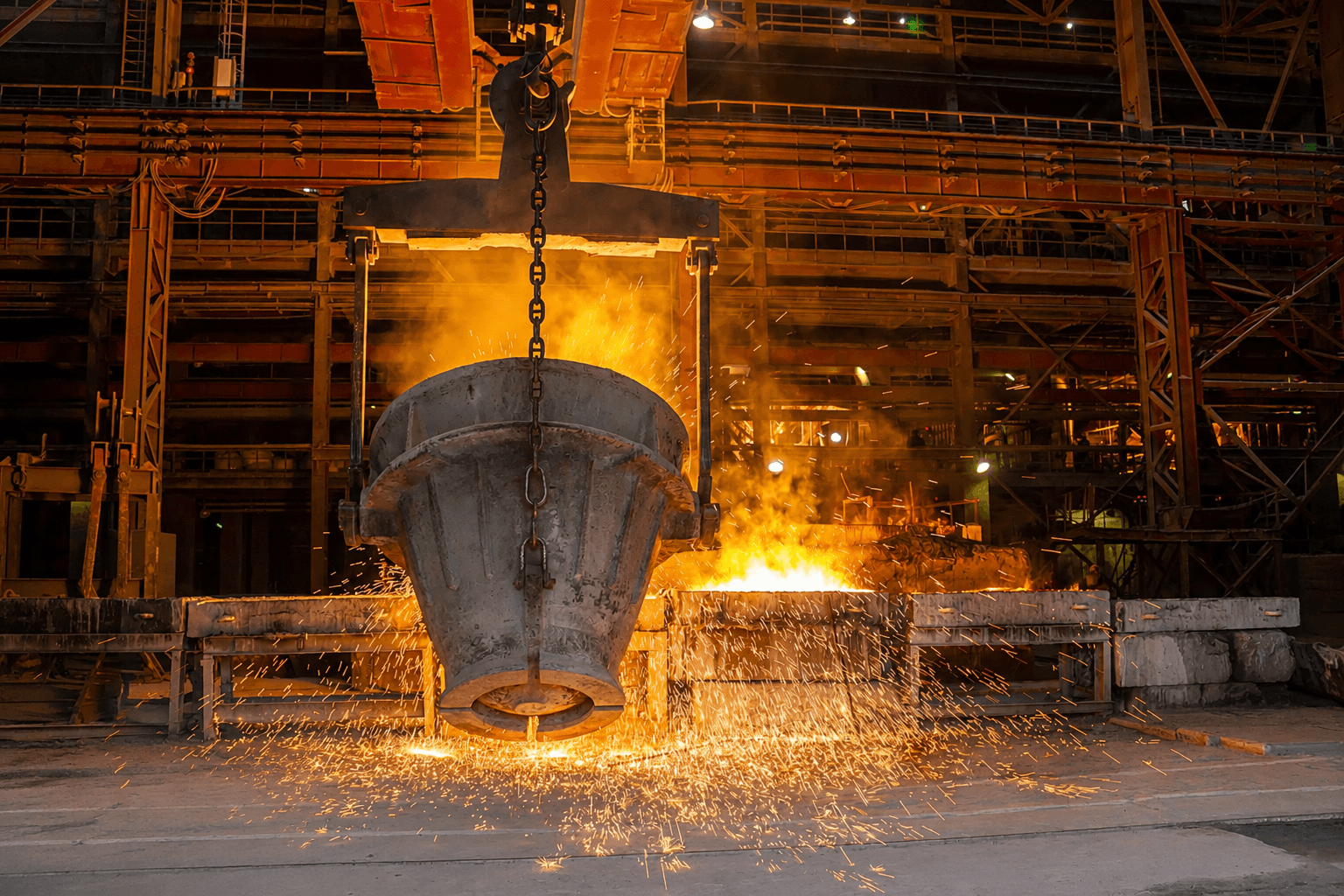
Steel manufacturing involves multiple high-temperature and material-handling processes, from raw material preparation and furnace charging to melting, refining, tapping and rolling. Each stage can generate particulate matter, fumes, process gases and combustion emissions.
For this reason, air pollution control equipment for steel plants needs to be selected according to the process, emission characteristics, gas volume, temperature and operating conditions of each unit.
In India, CPCB documentation identifies emission monitoring requirements across key steelmaking units, including sinter plants, blast furnaces, steel-making shops, rolling mills, arc furnaces and induction furnaces.
Why Air Pollution Control Is Important in Steel Plants
A steel plant can have several emission sources operating simultaneously. These include:
- Raw material handling and transfer
- Crushing and screening
- Furnace charging and melting
- Refining and tapping
- Slag handling
- Boiler and combustion exhaust
- Product handling and storage
Therefore, industrial air pollution control requires a combination of technologies rather than a single piece of equipment.
CPCB’s environmental standards include particulate-matter limits for different sections of integrated iron and steel plants, demonstrating the importance of process-specific emission control.
Major Air Pollution Control Equipment Used in Steel Plants
1. Furnace Fume Extraction Systems
A fume extraction system captures fumes generated directly from steelmaking operations.
In a Steel Melting Shop, emissions can occur during charging, melting, refining, and tapping. A furnace fume extraction system uses hoods, ducting, fans and downstream filtration equipment to capture and treat these process emissions.
Indian Environmental Clearance documentation for steel projects demonstrates the use of dust and fume extraction systems followed by bag filters for furnace emission control.
Fume extraction can include:
- Primary fume extraction
- Secondary fume extraction
- Furnace hoods
- Canopy extraction systems
- High-temperature ducting
A combination of primary and secondary Fume Capture Systems can provide comprehensive coverage across steel melting operations.
2. Baghouse Dust Collectors and Bag Filters
A Baghouse dust collector is widely used for particulate emission control in steel plants. Dust-laden gases pass through filter bags, where particulate matter is separated from the gas stream.
Common configurations include:
- Baghouse filter
- Pulsejet baghouse
- Reverse air baghouse
- Baghouse dust collection system
- Reverse air baghouse, dust collector
These systems can be applied to material handling, furnace operations, transfer points, and other particulate-generating processes.
Indian project approvals have specifically referenced bag filters for raw material handling, transfer points, steel melting shops, and furnace applications.
3. Electrostatic Precipitators
An electrostatic precipitator uses an electrical field to separate particulate matter from industrial gas streams.
Electrostatic precipitator systems are particularly relevant where large gas volumes need to be treated, including applications associated with boilers, power generation and selected steel plant processes.
CPCB identifies particulate matter as a relevant parameter for several steelmaking process stacks, including arc and induction furnaces.
Depending on the process, an industrial electrostatic precipitator can form part of a broader air pollution control system.
4. Gas Cleaning Systems
Steel plants can also require gas cleaning systems for process gases and combustion-related emissions.
Depending on the application, a system may include:
- Gas cleaning equipment
- Dust collectors
- Scrubbers
- ESP systems
- Filtration systems
- ID fans and associated ducting
Indian Environmental Clearance documents for steel projects have referenced combinations of ESPs, gas cleaning plants, Venturi scrubbers and bag filters for emission control.
This demonstrates why industrial gas cleaning needs to be approached according to the characteristics of the specific process gas.
5. Dust Collection Systems
Material handling areas are important sources of particulate emissions in steel plants. A properly designed dust collection system can capture dust from:
- Conveyors
- Crushers
- Screens
- Transfer points
- Storage areas
- Charging systems
An industrial dust collection system may incorporate hoods, ducting, fans, filters and dust discharge equipment.
Pre-collection can also be considered where the process generates larger particles or high dust loading. Pre-collectors can work alongside downstream filtration systems as part of an integrated configuration.
6. Scrubbers and Flue Gas Cleaning
Some steelmaking and associated processes may involve gases requiring specialized treatment. An industrial scrubber system uses liquid-based gas treatment, while specific applications may use exhaust gas scrubbers, Venturi scrubbers or other configurations.
Where sulfur-containing gases are present, technologies such as FGD technology, SO₂ scrubbing system or acid gas removal may be considered based on process conditions and gas composition.
The selection should always be based on process-specific gas characteristics rather than applying a single technology across every steel plant.
Primary and Secondary Emission Control
Steel melting operations generate fumes at different points, making both primary and secondary emission control important for effective industrial air pollution control.
Primary emission control captures fumes directly from the furnace during melting and refining. A suitable Fume Capture System, connected to ducting and filtration equipment such as a Baghouse filter or Industrial dust collector, helps collect particulate-laden gases close to the source.
Secondary emission control manages fumes released during activities such as charging, tapping and material handling. Canopy hoods, side-draft arrangements or other area extraction systems can be used to capture these emissions from the surrounding Steel Melting Shop.
When integrated, primary and secondary extraction provide comprehensive fume capture across the furnace and operating area. Ecomak designs such Air Pollution Control Solutions by considering furnace configuration, plant layout, gas flow requirements and process conditions.
Choosing Air Pollution Control Equipment for a Steel Plant
Selecting air pollution control equipment in industries requires consideration of several technical parameters:
- Type and concentration of pollutants
- Gas temperature
- Gas volume
- Dust characteristics
- Furnace operating cycle
- Required capture points
- Available installation space
- Filtration requirements
- Maintenance approach
- Future plant capacity
The right combination may include a dust collection system, baghouse collector, electrostatic precipitator, fume extraction system, scrubber or other emission control systems.
Indian CPCB studies on the iron and steel sector specifically consider the adequacy of pollution-control mechanisms and clean technologies across different steelmaking units.
Ecomak’s Approach to Air Pollution Control for Steel Plants
Ecomak Systems provides Industrial Air Pollution Control Systems designed for steelmaking applications, covering fume extraction, filtration, gas cooling and material-handling requirements.
Its steel plant portfolio includes baghouse systems, ESPs, scrubbers, FGD systems, ID fans, primary and secondary fume extraction systems and associated equipment.
For Steel Melting Shop applications, Ecomak develops solutions for induction furnaces, electric arc furnaces and refining furnaces, with systems designed around high-temperature fumes, particulate loading and continuous-duty operation.
This engineering-led approach allows air pollution control equipment manufacturers in India to address the complete emission-control requirement rather than treating individual equipment as isolated components.
Conclusion
Effective air pollution control for steel plants depends on matching the right technology with each emission source. Fume extraction systems, baghouse dust collectors, electrostatic precipitators, dust collection systems, scrubbers and gas cleaning systems each have specific applications.
For steel manufacturers evaluating new installations, capacity expansions or upgrades, an integrated approach can help align emission capture, filtration, gas treatment and plant operation.
Ecomak combines process understanding, engineering, manufacturing and EPC capabilities to develop Air Pollution Control Solutions for steelmaking and other energy-intensive industries. Its solutions are designed around actual plant conditions, enabling a coordinated approach to industrial emissions air pollution control.
FAQs
What is a furnace fume extraction system?
A furnace fume extraction system captures fumes generated during steel melting, refining and tapping and transfers them through ducting to appropriate filtration or treatment equipment.
Are baghouse dust collectors used in steel melting shops?
Yes. Baghouse dust collectors and bag-filter systems are used in various steel plant applications for particulate control, including furnace fume extraction and material-handling systems. Indian Environmental Clearance documents provide examples of such configurations.
What is the role of primary and secondary fume extraction?
Primary extraction captures emissions close to the furnace, while secondary extraction captures emissions generated around the wider steel melting shop. Together, they provide broader Fume Capture Systems coverage.
How should a steel plant select air pollution control equipment?
Selection should consider pollutant characteristics, gas volume and temperature, dust loading, process cycle, capture requirements, filtration technology, available space and long-term operating requirements.