



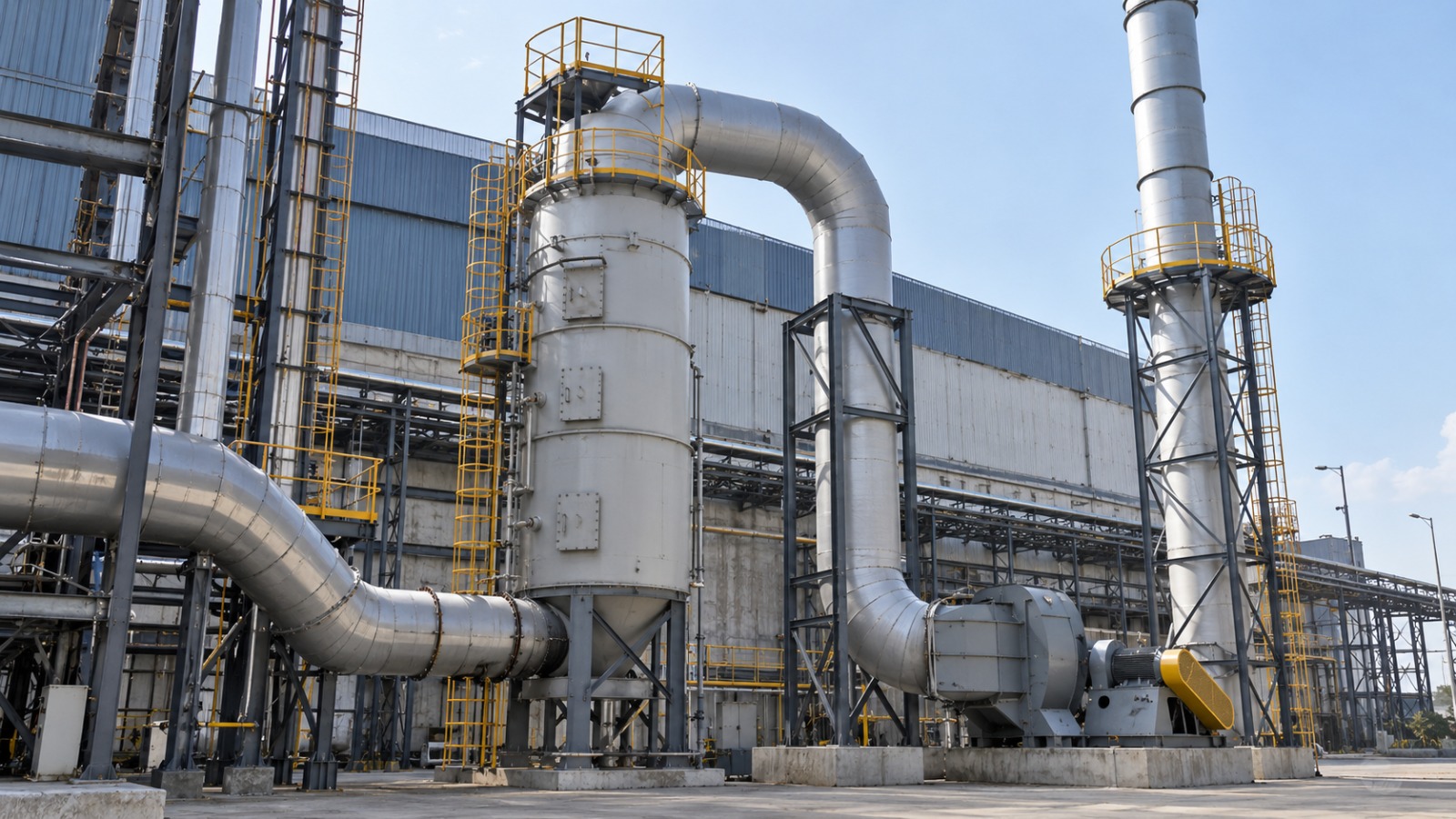
Industrial manufacturing processes can generate particulate matter, acidic gases, chemical vapours, fumes and other gaseous pollutants. Depending on the characteristics of the exhaust stream, industries use specialised air pollution control equipment to capture and treat these emissions.
An Industrial scrubber system is a gas-cleaning technology that uses liquid–gas contact to remove targeted pollutants from industrial exhaust streams. Scrubbers are particularly useful for acid gas removal, soluble gases, fine particulates and process fumes, making them an important part of modern Industrial Air Pollution Control Systems.
This guide explains what an industrial scrubber is, how it works, the major types of scrubbers, and where they are used across industries.
What Is an Industrial Scrubber System?
An Industrial scrubber system is an air pollution control system designed to remove gaseous pollutants and, depending on the configuration, particulate matter from an industrial gas stream.
In a typical wet scrubber, contaminated gas comes into contact with a scrubbing liquid. The liquid captures or absorbs the target pollutants, after which the treated gas exits the scrubber while the collected liquid and solids are directed for appropriate handling.
The Central Pollution Control Board describes wet scrubbers as systems in which droplets contact particulate matter in an incoming gas stream; wet scrubbers can also be used for removing gases from air streams.
How Does an Industrial Scrubber Work?
The industrial scrubber working principle is based on increasing contact between the process gas and a suitable scrubbing liquid.
1. Gas Entry
The process exhaust enters the scrubber at a controlled flow rate. Gas temperature, pollutant concentration and gas composition are important inputs for system design.
2. Gas–Liquid Contact
Scrubbing liquid is introduced through spray nozzles, packing or a high-velocity contact section, depending on the scrubber design.
The increased contact area allows soluble gases and/or particulate matter to transfer from the gas phase into the liquid.
3. Pollutant Removal
For gaseous pollutants, absorption or chemical reaction can take place between the pollutant and scrubbing liquid. For particulate control, droplets can capture suspended particles.
4. Droplet Separation
A mist eliminator or similar separation arrangement removes entrained liquid droplets from the treated gas before it leaves the scrubber.
5. Liquid Management
The collected liquid is recirculated, replenished or treated according to the process chemistry and system design.
This makes the scrubber part of a complete Gas cleaning systems approach rather than an isolated piece of equipment.
Major Types of Industrial Scrubber Systems
Different process conditions require different scrubber configurations.
1. Venturi Scrubber
A Venturi scrubber accelerates the gas through a narrow throat while introducing scrubbing liquid. The resulting high-energy gas–liquid contact enables effective particulate and fume capture.
It can be suitable for applications involving fine particulate, high-temperature gas streams and process fumes.
2. Spray Tower Scrubber
A spray tower introduces liquid through nozzles to create droplets that contact the incoming gas.
It can provide gas cooling, absorption of soluble pollutants and particulate capture depending on the application.
3. Packed Bed Scrubber
A packed bed scrubber contains packing material that increases the contact surface between gas and liquid.
It is particularly suitable for acid gas removal and absorption of soluble gases such as HCl, HF, SO₂ and NH₃, depending on process chemistry and reagent selection.
Ecomak’s scrubber portfolio includes Venturi, Spray Tower and Packed Bed configurations for applications involving particulates, acidic gases and process pollutants.
What Pollutants Can an Industrial Scrubber Remove?
The pollutants treated depend on scrubber design, liquid chemistry, operating conditions and gas characteristics.
Common applications include:
- Acid gas removal
- SO₂ removal through an SO2 scrubbing system
- HCl and HF absorption
- Chemical vapour treatment
- Fine particulate and fume capture
- Process gas cleaning
- Gas cooling
- Odour and selected gaseous pollutant control
For example, Indian environmental-clearance documentation includes wet scrubbers for process emissions, acid mist and specific chemical-process exhaust streams.
Industrial Scrubber System Applications
Chemical Industry
Chemical manufacturing can generate acidic and alkaline gases, vapours and process emissions. A suitably designed scrubber provides targeted gas absorption and forms an important component of Air Pollution Control technology for the chemical industry.
Packed bed and multi-stage configurations can be selected according to the pollutant chemistry.
Power Plants and Boilers
Certain boiler applications use wet scrubbers as part of their Boiler exhaust system, particularly where specific gas or particulate characteristics make wet treatment suitable.
Indian regulatory/project documentation provides examples of wet scrubbers being used with boiler and process emission sources.
Steel and Metallurgical Industries
Metallurgical processes can generate high-temperature gases, fumes and particulate matter. Depending on the process, scrubbers can complement the Dust collection system, bag filters and other Industrial air pollution control technologies.
Venturi scrubbers can be considered where fine particulate and hot gas treatment are required.
Cement and Mineral Processing
Scrubbers may be used for selected process gas and particulate applications, depending on the gas characteristics and overall plant configuration.
Carbon Black Manufacturing
The Carbon black process generates process gases requiring carefully selected gas-cleaning technologies. Scrubbers can form part of integrated Gas cleaning systems where wet treatment is appropriate for the specific gas stream.
Key Factors in Scrubber System Design
An efficient Pollution control system for industries should be designed around the actual process rather than using a standard configuration for every application.
Key parameters include:
- Gas flow rate
- Gas temperature
- Pollutant concentration
- Gas chemistry
- Required removal efficiency
- Scrubbing liquid and reagent selection
- Liquid-to-gas ratio
- Pressure drop
- Corrosion considerations
- Mist elimination
- Recirculation arrangement
- Sludge/liquid handling
- Material of construction
These parameters determine the appropriate scrubber type, dimensions, internals, fan requirements and auxiliary systems.
Ecomak’s Approach to Industrial Scrubber Systems
Ecomak Systems designs and delivers Industrial scrubber systems for gas cleaning and emission-control applications across industries including steel, power, cement, chemical and mineral processing.
Its portfolio includes Venturi scrubbers, Spray Tower scrubbers and Packed Bed scrubbers, with configurations selected according to gas flow, pollutant characteristics and operating conditions.
Ecomak also integrates scrubbers with other air pollution control equipment where a process requires multiple stages of particulate and gas treatment. This approach allows the overall Emission control systems to be engineered around the process, rather than selecting individual equipment independently.
Conclusion
An Industrial scrubber system is a versatile component of modern Industrial air pollution control. By using controlled gas–liquid contact, scrubbers can address suitable particulate, acidic-gas and gaseous-pollutant applications across chemical, steel, power, cement and other process industries.
The most suitable system depends on the gas composition, pollutant characteristics, temperature, flow rate and required treatment objectives. For complex applications, combining scrubbers with complementary air pollution control systems can create a comprehensive Industrial air emission control solution.
For industries evaluating a new installation or upgrading an existing system, an experienced air pollution control equipment manufacturer in India can help translate process conditions into the appropriate scrubber configuration, auxiliaries and integrated EPC solutions.
What is an industrial scrubber system?
An Industrial scrubber system is an air-pollution-control technology that brings industrial exhaust gases into contact with a liquid to remove targeted gaseous pollutants and, depending on the design, particulate matter.
What is the working principle of a wet scrubber?
A wet scrubber works by creating contact between contaminated gas and liquid droplets or a liquid film. Pollutants are captured through absorption, chemical reaction and/or particulate collection, depending on the scrubber configuration.
What is the difference between a Venturi and packed bed scrubber?
A Venturi scrubber is generally suited to high-energy gas–liquid contact and fine particulate capture, while a packed bed scrubber provides a large contact surface for gas absorption and is commonly used for soluble and acidic gases.
Can scrubbers remove SO₂?
Yes. Appropriately designed wet scrubbers can be used as SO2 scrubbing systems for sulfur dioxide removal. The process chemistry, reagent and operating conditions determine the achievable treatment performance.
Are scrubbers used for particulate removal?
Yes. Wet scrubbers can capture particulate matter, with Venturi scrubbers particularly suited to applications requiring high-energy gas–liquid contact.
Can a scrubber be combined with a baghouse or ESP?
Yes. A scrubber can be integrated with a Baghouse dust collection system, Electrostatic precipitator systems or pre-collection equipment when the overall process requires multiple stages of emission treatment.