



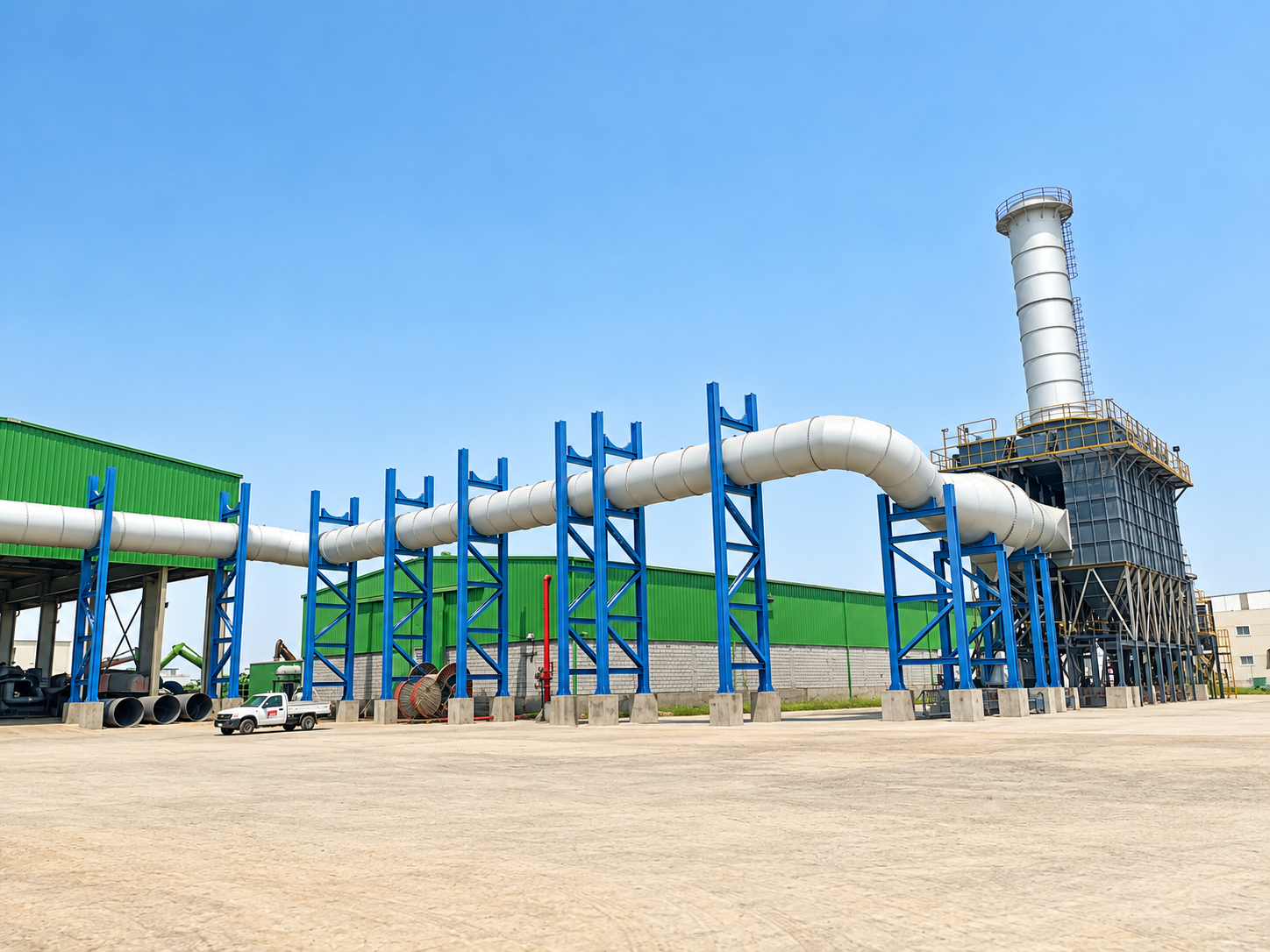
Induction furnaces are widely used in Steel Melting Shops for melting steel, iron and other metals. During charging, melting and tapping, the process generates particulate-laden fumes that need to be captured and treated through a properly engineered Fume Extraction System.
A well-designed Furnace fume extraction system combines source capture, ducting, spark protection, filtration, induced-draft fans and stack arrangements to provide effective Industrial air pollution control.
This guide explains how Fume Extraction Systems for Induction Furnaces work, their key components, primary and secondary fume capture, filtration options and the factors plants should consider when selecting a system.
What Is a Fume Extraction System for an Induction Furnace?
A Fume extraction system is an engineered arrangement that captures fumes generated during induction furnace operations and conveys them to an Air pollution control equipment system for filtration before controlled discharge.
The system generally consists of:
- Furnace hood or Fume Capture Systems
- Suction and ducting network
- Spark arrestor or pre-collection arrangement
- Baghouse filter / Baghouse dust collector
- ID fan
- Stack and associated controls
Indian environmental project documents for induction furnace facilities commonly specify fume-capturing hoods connected to bag filters and stacks.
How Does an Induction Furnace Fume Extraction System Work?
The working principle is straightforward:
Furnace → Hood → Duct → Spark Arrestor/Pre-collector → Baghouse → ID Fan → Stack
During melting, the hood captures fumes close to their generation point. The extraction fan creates the required suction to transport the gas through the duct network.
Where required, a spark arrestor or Pre-collectors can provide initial separation and spark protection before the gas reaches the filtration stage. The gas then enters a Baghouse dust collection system, where particulate matter is separated using filter bags.
The cleaned gas is finally discharged through a stack designed according to the plant’s applicable requirements.
Indian environmental documentation also describes induction furnace systems using hood capture, ID fans, heat/spark control and baghouse filtration.
Primary and Secondary Fume Capture
Effective extraction from an induction furnace involves more than simply connecting a hood to a filter.
Primary Fume Extraction
Primary extraction captures fumes directly from the furnace during melting and other high-emission operating stages. A swivelling or appropriately positioned hood can maintain effective capture while allowing furnace movement and operational access.
Secondary Fume Extraction
Secondary emissions can occur around the furnace during charging, tapping and material movement. Depending on the Steel Melting Shop layout, secondary extraction may use side suction arrangements, canopy systems, roof-level extraction or other area capture solutions.
For plants operating multiple furnaces, integrating primary and secondary extraction can provide more comprehensive Industrial air emission control.
Ecomak’s primary and secondary FES approach is designed for furnace configurations including induction furnaces, with customised extraction, ducting and fan arrangements based on the plant layout.
Why Is Baghouse Filtration Commonly Used?
A Baghouse filter is a practical filtration technology for particulate-laden gases from induction furnace operations. As the gas passes through filter bags, particulate matter is retained on the filtration surface while cleaned gas passes through.
Different applications can use different baghouse configurations, including Pulsejet baghouse systems. The appropriate filter media and cleaning arrangement should be selected according to gas temperature, particulate characteristics, moisture, chemistry and operating conditions.
Indian environmental clearance documents for steel projects frequently identify Fume extraction systems with bag filters for controlling particulate emissions from induction furnaces.
Factors to Consider When Designing a Fume Extraction System
The performance of an induction furnace extraction system depends on the complete system design rather than the filtration equipment alone.
Important design considerations include:
- Furnace capacity and number of furnaces
- Furnace operating cycle
- Hood position and capture geometry
- Required airflow and suction
- Duct velocity and pressure drop
- Gas temperature
- Spark and hot-particle management
- Filter media selection
- Baghouse sizing
- ID fan selection
- Stack arrangement
- Primary and secondary capture requirements
- Future plant expansion
Proper airflow balancing is particularly important when multiple furnaces are connected to a common Dust collection system.
Ecomak’s Approach to Induction Furnace Fume Extraction
Ecomak Systems integrates Fume Capture Systems, filtration, and air movement into application-specific Air Pollution Control Solutions for steelmaking operations.
For Steel Melting Shop applications, the system can be engineered around induction furnaces and other furnace configurations, with attention to furnace layout, extraction requirements, ducting, filtration and fan performance.
Ecomak’s primary + secondary FES solutions are designed to accommodate Induction Furnaces, EAFs and LRFs, with customised ducting and extraction arrangements for different shop layouts.
This engineering-led approach helps integrate Industrial Air Pollution Control Systems with the actual production process rather than treating the filtration unit as an isolated piece of equipment.
How to Select the Right Induction Furnace Fume Extraction System
Before selecting an air pollution control equipment manufacturer, evaluate the complete system:
- Understand the furnace process – Identify when and where fumes are generated.
- Assess capture requirements – Determine primary and secondary extraction needs.
- Calculate airflow requirements – Size the system around actual furnace and shop conditions.
- Select appropriate filtration – Consider baghouse configuration and filter media.
- Review spark and temperature control – Provide suitable protection before filtration.
- Evaluate fan and duct design – Optimise pressure drop and airflow distribution.
- Expansion plan – Allow the system to accommodate future furnace additions.
- Consider complete EPC capability – An experienced provider can integrate design, equipment, installation and commissioning.
Conclusion
A properly engineered Fume Extraction System is an important part of Industrial air pollution control in induction-based steelmaking. Effective performance depends on the complete chain from furnace hood and airflow design to ducting, spark management, Baghouse dust collector, ID fan, and stack.
For modern steel melting shops, combining primary and secondary Fume Capture Systems can provide a more comprehensive approach to process emission management. Selecting an experienced air pollution control equipment manufacturer in India with capabilities across design, filtration, extraction, and project execution can further support reliable system integration.
What is a fume extraction system for an induction furnace?
A Fume extraction system for an induction furnace captures process fumes at or around the furnace, transports them through ducting and treats the extracted gas through filtration equipment such as a baghouse before controlled discharge.
Which filter is commonly used with induction furnace fume extraction?
A Baghouse filter or bag filter is commonly used for particulate filtration in induction furnace applications. The appropriate configuration depends on gas temperature, particulate characteristics, airflow and plant requirements.
What is primary fume extraction?
Primary fume extraction captures fumes directly from the furnace using a suitably positioned hood or extraction arrangement.
What is secondary fume extraction?
Secondary fume extraction captures fumes released around the furnace and operating area, such as during charging, tapping and material handling. The arrangement can include canopy, side-suction or other area capture systems.
Why is a spark arrestor used in an induction furnace FES?
A spark arrestor can provide separation of sparks and coarse hot particles before the gas reaches downstream filtration equipment, supporting appropriate protection of the filtration system.
Can one FES serve multiple induction furnaces?
Yes. Multiple furnaces can be connected to a common extraction and filtration system when the airflow, ducting, fan capacity, control arrangement and operating sequence are appropriately engineered.
What is the role of an ID fan?
The induced draft fan creates the suction required to draw furnace fumes through the hood, ductwork and filtration system and move the treated gas towards the stack.